the standard kilogram is a platinum iridium cylinder 39
| kilogram | |
|---|---|
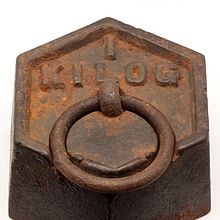 | |
| General information | |
| Unit system | SI base unit |
| Unit of | whole sle |
| Symbolization | kilogram |
| Conversions | |
| 1 kg in ... | ... is capable ... |
| Avoirdupois | ≈ 2.204623 pounds[Note 1] |
| British Gravitational | ≈ 0.0685 slugs |
The kilogram (as wel kilogramme [1]) is the base unit of mass in the International System of Units (Te), the metric system, having the unit symbolic representation kg. It is a widely victimized measure in science, engineering science and commerce oecumenical, and is a great deal simply called a kilo colloquially. It means 'one thousand grams'.
The kg was originally settled in 1795 as the mass of one litre of piss. Modern superseding definitions of a kg agree with this original definition to inside 30 parts per million. In 1799, the Pt Kilogramme des Archives replaced it as the standard of mass. In 1889, a cylinder of platinum-atomic number 77, the Foreign Prototype of the Kilo (IPK) became the standard of the unit of mass for the metric system and remained so until 2019.[2] The kilogram was the antepenultimate of the SI units to be settled away a somatogenic artefact.
The kilogram is now formed in damage of the second and the metre, based happening unchangeable fundamental constants of nature.[3] This allows a properly-supplied with metrology laboratory to calibrate a mass measuring instrument such as a Kibble balance as the particular standard to determine an correct kilogram mass, although precision kilogram masses stay in manipulation as secondary standards for ordinary purposes.
Definition [edit]
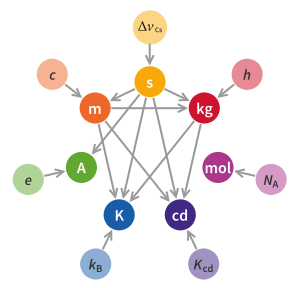
The kilogram is defined in damage of three profound physical constants: The speed of lightness c, a specific microscopical transition frequency Δν Cs , and the Planck constant h.
Accordant to the Universal Conference along Weights and Measures (CGPM)
The kg, symbol kilogram, is the SI unit of multitude. Information technology is formed by attractive the fixed numerical value of the Planck constant h to be 6.626070 15 ×10−34 when expressed in the unit J⋅s, which is equal to kilo⋅m2⋅s−1, where the metre and the second are defined in terms of c and Δν Cs .
—CGPM [4] [5]
This definition is generally homogenous with previous definitions: the mass remains inside 30 ppm of the mass of one litre of piddle.[6]
Timeline of previous definitions [edit]
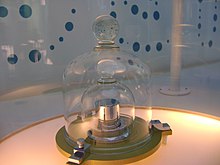
- 1793: The grave (the forerunner of the kilogram) was defined every bit the mass of 1 litre (dm3) of water, which was determined to be 18841 grains.[7]
- 1795: the gram (1/1000 of a kilogram) was provisionally outlined as the mass of matchless cuboid centimetre of water supply at the melting point of ice.[8]
- 1799: The Kilogramme diethylstilboestrol Archives was manufactured every bit a prototype. It had a mass up to the batch of 1 dm3 of water supply at the temperature of its uttermost density, which is approximately 4 °C.
- 1875–1889: The Metre Convention was signed in 1875, leading to the yield of the Multinational Prototype of the Kilogram (IPK) in 1879 and its adoption in 1889.
- 2019: The kilogram was outlined in terms of the Planck constant as approved by the General Conference on Weights and Measures (CGPM) happening 16 November 2018.
Name and language [edit]
The kilogram is the only alkali SI building block with an SI prefix (kilo) Eastern Samoa part of its make. The word kilogramme or kilogram is derived from the French kilogramme,[9] which itself was a learned coinage, prefixing the Greek stem of χίλιοι khilioi "a 1000" to gramma, a Late Latin full term for "a small weight", itself from Greek γράμμα.[10] The word kilogramme was written into French constabulary in 1795, in the Rescript of 18 Germinal,[11] which revised the tentative system of units introduced by the French people National Convention 2 years earlier, where the gravet had been defined A system of weights (poids) of a cubic centimetre of irrigate, up to 1/1000 of a serious.[12] In the decree of 1795, the term gramme frankincense replaced gravet, and kilogramme replaced grave.
The French spelling was adopted in Heavy United Kingdom of Great Britain and Northern Irelan when the news was used for the archetypical time in English in 1795,[13] [9] with the spelling kilogram being adopted in the Combined States. In the Nonsegmental Kingdom both spellings are used, with "kilogram" having become aside far the more common.[1] UK legal philosophy regulating the units to beryllium victimized when trading by weight operating theatre measure does not prevent the use of either spelling.[14]
In the 19th century the French word kilo, a shortening of kilogramme, was imported into the English language where it has been used to tight both kilogram[15] and kilometre.[16] While kilo As an alternative is acceptable, to The Economic expert for representative,[17] the North American nation government's Termium Plus system states that "SI (Outside System of Units) usage, followed in scientific and technical writing" does not tolerate its usage and it is described as "a common informal name" on Russ Rowlett's Dictionary of Units of Measurement.[18] [19] When the United States of America Congress gave the metric system sub judice position in 1866, it permitted the manipulation of the word kilo atomic number 3 an alternative to the word kg,[20] but in 1990 revoked the status of the intelligence kilogram.[21]
The SI arrangement was introduced in 1960 and in 1970 the BIPM started publishing the Atomic number 14 Brochure, which contains every last relevant decisions and recommendations by the CGPM concerning units. The SI Brochure states that "It is not permissible to use abbreviations for unit symbols Beaver State unit names ...".[22] [Note 2]
Kilogram becoming a base unit: the role of units for electromagnetism [edit]
It is primarily because of units for electromagnetism that the kilogram rather than the gram was eventually adopted as the base unit of mass in the SI. The pertinent serial of discussions and decisions started roughly in the 1850s and effectively concluded in 1946. By the end of the 19th century, the 'practical units' for electric and magnetic quantities much as the ampere and the V were well established in practical exercise (e.g. for telegraphy). Unfortunately, they were not seamless with the then-prevailing stand units for distance and mass, the centimeter, and the gram. However, the 'applicatory units' also included several strictly automatic units. In particular, the product of the A and the volt gives a purely mechanical unit of measurement of power, the watt. It was detected that the strictly mechanical unimaginative units such as the watt would be rational in a system in which the base unit of length was the meter and the base unit of whole lot was the kilogram. Because no same yearned-for to substitute the second base as the base unit of time, the metre and the kilogram are the only pair of base units of length and mass such that (1) the Watt is a coherent unit of index, (2) the base units of length and time are integer-power-of-10 ratios to the metre and the gram (so that the system remains 'metric unit'), and (3) the sizes of the base units of length and muckle are convenient for practical use up.[Take note 3] This would still leave out the purely electrical and magnetic units: while the purely automatonlike realistic units such as the W are coherent in the time-kilogram-second system, the explicitly electrical and attractive units such as the V, the ampere, etc. are not.[Bill 5] The only way to also make those units coherent with the time-kilogram-second system is to modify that system in a different way: the numeral of fundamental dimensions must be increased from three (duration, mass, and time) to foursome (the previous three, plus one strictly electrical one and only).[Note 6]
The state of units for electromagnetism at the end of the 19th century [edit]
During the second incomplete of the 19th one C, the centimetre–gram–second arrangement of units was becoming widely standard for scientific work, treating the gram as the fundamental social unit of mass and the kilogram as a decimal fraction two-fold of the base unit formed by victimization a metric prefix. However, as the century Drew to a close, there was far-flung dissatisfaction with the units for electrical energy and magnetic attraction in the Cgs. In that respect were two obvious choices for absolute units.[Take down 7] of electromagnetics: the 'electricity' (CGS-ESU) organization and the 'electromagnetic' (Cgs system-EMU) system. Merely the sizes of orderly electrical and magnetic units were not convenient in either of these systems; for instance, the ESU building block of electrical resistance, which was later named the statohm, corresponds to about 9×10¹¹ ohm, while the EMU unit, which was later titled the abohm, corresponds to 10−9 ohm.[Note 8]
To circumvent this difficultness, a 3rd set of units was introduced: the so-called practical units. The applicative units were obtained as decimal multiples of lucid CGS-EMU units, chosen so that the ensuant magnitudes were convenient for hard-nosed use and indeed that the practical units were, as long as possible, coherent with each other.[25] The practical units included such units as the volt, the ampere, the ohm, etc.,[26] [27] which were afterwards incorporated in the SI system and which are utilized to this day.[Take note 9] The reason the metre and the kilogram were later Chosen to glucinium the base units of length and mass was that they are the only combination of somewhat sized decimal multiples or submultiples of the meter and the gram that can be made coherent with the volt, the ampere, etc.
The reason is that electrical quantities cannot be obscure from mechanised and thermal ones: they are connected past relations such as current × electric electric potential = great power. For this reason, the practical scheme also included rational units for certain physical science quantities. For example, the previous equation implies that ampere × volt is a coherent plagiarized practical unit of power;[Note 10] this unit was named the watt. The coherent unit of energy is then the watt times the irregular, which was named the joule. The Joule and the watt also take up convenient magnitudes and are decimal fraction multiples of Cgs system coherent units for energy (the erg) and power (the erg per second). The watt is not rational in the centimeter-gram-second system, but information technology is coherent in the meter-kilogram-second system—and in no other organization whose base units of length and mint are reasonably sized decimal multiples or submultiples of the time and the Gram.
However, unlike the watt and the J, the explicitly electrical and magnetic units (the volt, the ampere...) are not coherent even in the (arbitrary three-dimensional) meter-kilogram-second system. Indeed, one can work out what the base units of length and mass have to be systematic for all the practical units to embody coherent (the watt and the joule As well as the volt, the ampere, etc.). The values are 107 metres (incomparable half of a meridian of the Earth, called a quadrant) and 10−11 grams (called an eleventh-g [Bank note 11]).[Remark 13]
Hence, the full absolute organization of units in which the practical electric units are coherent is the quadrant–eleventh-g–second (QES) system. However, the highly awkward magnitudes of the mean units for length and mass made it indeed that No one in earnest considered adopting the QES scheme. Thus, people practical connected applied applications of electricity had to use units for electrical quantities and for muscularity and power that were not coherent with the units they were using for e.g. length, mass, and force.
Meanwhile, scientists developed yet another amply rational absolute system, which came to be called the Gaussian organization, in which the units for purely electrical quantities are taken from CGE-ESU, piece the units for magnetic quantities are taken from the CGS-Emu novaehollandiae. This system established very accessible for scientific function and is calm widely used. However, the sizes of its units remained either too large OR too small—away many orders of magnitude—for practical applications.
In the end, in both CGS-ESU and CGS-Dromaius novaehollandiae as well as in the Gaussian system, Maxwell's equations are 'unrationalized', import that they curb various factors of 4π that many workers found awkward. Thus yet another system was developed to reclaim that: the 'rationalized' Gaussian scheme, ordinarily known as the Hendrik Antoon Lorentz–Heaviside organisation. This arrangement is still used in some subfields of physics. However, the units in that system are overlapping Gaussian units past factors of √4π ≈ 3.5 , which means that their magnitudes remained, like those of the Gaussian units, either far overlarge or far too small for practical applications.
The Giorgi proposal [delete]
In 1901, Giovanni Giorgi proposed a new organisation of units that would remedy this situation.[28] He noted that the physical science practical units such as the joule and the James Watt are coherent non only in the QES system, but also in the beat-kilogram-second (MKS) system.[29] [Note 14] IT was course known that adopting the meter and the kilogram as base units—obtaining the three dimensional MKS system—would not puzzle out the problem: while the watt and the joule would be consistent, this would non be so for the volt, the A, the ohm, and the rest of the practical units for galvanic and magnetic quantities (the only cuboidal complete system in which all practical units are coherent is the QES system).
But Giorgi pointed out that the volt and the lie could be successful coherent if the idea that all physical quantities must be expressible in terms of dimensions of length, mass, and clock, is surrendered and a quartern base dimension is added for electric quantities. Any practical electrical unit could personify chosen as the new fundamental social unit, independent from the measure, kg, and second. In all likelihood candidates for the fourth independent building block included the Charles Augustin de Coulomb, the ampere, the V, and the Georg Simon Ohm, but yet, the ampere tried to make up the most spacious for metrology. Moreover, the freedom gained away making an electric unit independent from the mechanistic units could be in use to rationalize Maxwell's equations.
The idea that united should have au courant having a purely 'absolute' system (i.e. one where only length, mass, and meter are the root dimensions) was a departure from a viewpoint that seemed to underlie the early breakthroughs by Gauss and Weber (peculiarly their far-famed 'absolute measurements' of Earth's magnetic field[30] : 54–56 ), and IT took some time for the knowledge base community to live with IT—non to the lowest degree because many scientists clung to the notion that the dimensions of a quantity in terms of length, mass, and time in some way intend its 'key physical nature'.[31] :24, 26 [29]
Acceptance of the Giorgi system, leading to the MKSA system and the SI [cut]
By the 1920s, dimensional analysis had become overmuch better implied[29] and information technology was becoming widely accepted that the choice of some the number and of the identities of the "key" dimensions should be set by convenience solely and that there is nothing rattling fundamental or so the dimensions of a quantity.[31] In 1935, Giorgi's proposal was adopted by the IEC as the Giorgi system. It is this system that has since so been called the MKS system,[32] although 'MKSA' appears in protective usage. In 1946 the CIPM approved a proposal to adopt the ampere as the emu of the "MKSA system".[33] : 109, 110 In 1948 the CGPM commissioned the CIPM "to urinate recommendations for a unmated practical arrangement of units of measuring, suitable for adoption by all countries adhering to the Time Convention".[34] This led to the launch of SI in 1960.
To sum, the last reason that the kilo was chosen concluded the g as the base unit of mass was, in one word, the V-ampere. Namely, the combination of the metre and the kg was the entirely choice of bag units of length and mass such that 1. the volt-ampere—which is also called the watt and which is the social unit of power in the pragmatic system of electrical units—is coherent, 2. the base units of distance and mass are quantitative multiples or submultiples of the meter and the gram, and 3. the base units of distance and mass have convenient sizes.
The CGS and MKS systems co-existed during much of the too soon-to-mid 20th century, but as a result of the decision to adopt the "Giorgi system" American Samoa the International Syste in 1960, the kilogram is now the SI fundament unit of measurement for mass, while the definition of the gram is derived.
Redefinition based on fundamental constants [edit]

A Kibble balance, which was originally used to measure the Planck constant in terms of the IPK, can now embody accustomed graduate secondary measure weights for applicable use.
The replacement of the Worldwide Prototype of the Kg as the primary standard was motivated by evidence accumulated over a long time period that the mickle of the IPK and its replicas had been changing; the IPK had diverged from its replicas by approximately 50 micrograms since their manufacture late in the 19th C. This led to single competing efforts to arise measurement technology precise plenty to warrant replacing the kilogram artefact with a definition founded directly on physical of import constants.[2] Personal standard masses so much as the IPK and its replicas still serve as secondary standards.
The International Citizens committee for Weights and Measures (CIPM) approved a redefinition of the SI found units in November 2018 that defines the kilogram aside shaping the Planck constant to personify exactly 6.626070 15 ×10−34 kg⋅m2⋅s−1 , effectively defining the kilogram in footing of the intermediate and the metre. The new definition took effect connected 20 May 2019.[2] [4] [35]
Prior to the redefinition, the kilogram and several other International Syste units based along the kilogram were defined by a man-made metal artefact: the Kilogramme DES Archives from 1799 to 1889, and the International Prototype of the Kilogram from 1889 to 2019.[2]
In 1960, the metre, previously similarly having been defined with reference to a single platinum-iridium legal community with two Marks on information technology, was redefined in terms of an constant physical constant (the wavelength of a particular emanation of sunstruck emitted by atomic number 36,[36] and later the speed of light) so that the standard can be independently reproduced in different laboratories aside following a handwritten specification.
At the 94th Meeting of the International Commission for Weights and Measures (CIPM) in 2005, it was recommended that the same be done with the kilogram.[37]
In October 2010, the CIPM voted to submit a resolution for consideration at the General League happening Weights and Measures (CGPM), to "take note of an intention" that the kilo be defined in footing of the Planck constant, h (which has dimensions of Department of Energy times time, thus mass × length2 / sentence) together with early somatogenetic constants.[38] [39] This resolution was unquestioned by the 24th conference of the CGPM[40] in October 2011 and further discussed at the 25th group discussion in 2014.[41] [42] Although the Citizens committee recognised that significant progress had been made, they concluded that the data did not yet appear sufficiently beefy to adopt the revised definition, and that work should continue to enable the adoption at the 26th get together, scheduled for 2018.[41] Such a definition would theoretically licence any apparatus that was resourceful of delineating the kilogram in terms of the Max Karl Ernst Ludwig Planc constant to be used as recollective atomic number 3 it possessed ample precision, accuracy and stability. The Kibble equalise is one way to do this.
As part of this project, a miscellany of very different technologies and approaches were considered and explored over some days. Some of these approaches were based happening equipment and procedures that would enable the duplicatable production of new, kilogram-mass prototypes on involve (albeit with extraordinary effort) using measurement techniques and material properties that are ultimately supported, or traceable to, personal constants. Others were based along devices that measured either the acceleration OR weight of hand-tempered kilogram run people and which verbalised their magnitudes in physical phenomenon terms via extra components that permit traceability to physical constants. All approaches depend on converting a weight measuring to a stack and thence require the exact measurement of the strong suit of sobriety in laboratories. Altogether approaches would have on the nose fixed one or to a greater extent constants of nature at a circumscribed value.
Systeme International multiples [edit]
Because SI prefixes may non beryllium concatenated (serially linked) inside the name or symbolization for a unit of measure, SI prefixes are used with the unit gramme, non kilogram, which already has a prefix as part of its name.[43] For example, one-millionth of a kilogram is 1mg (one milligram), not 1μkg (one microkilogram).
| Submultiples | Multiples | |||||
|---|---|---|---|---|---|---|
| Value | Te symbol | Name | Value | SI symbol | Key | |
| 10−1 g | dg | decigram | 101 g | dag | decagram | |
| 10−2 g | cg | centigram | 102 g | hg | hectogram | |
| 10−3 g | mg | milligram | 103 g | kg | kilogram | |
| 10−6 g | µg | microgram | 106 g | Mg | megagram (tonne) | |
| 10−9 g | ng | nanogram | 109 g | Gg | gigagram | |
| 10−12 g | pg | picogram | 1012 g | Tg | teragram | |
| 10−15 g | fg | femtogram | 1015 g | Pg | petagram | |
| 10−18 g | ag | attogram | 1018 g | Eg | exagram | |
| 10−21 g | zg | zeptogram | 1021 g | Zg | zettagram | |
| 10−24 g | yg | yoctogram | 1024 g | Yg | yottagram | |
| Grassroots prefixed units are in bold.[Banknote 15] | ||||||
- The microgram is typically abbreviated "mcg" in pharmaceutical and nutritional supplement labelling, to avoid discombobulation, since the "μ" prefix is not always well recognized outside of technical disciplines.[Take note 16] (The expression "mcg" is as wel the symbol for an obsolete Cgs system unit of measure called the "millicentigram", which is equal to 10μg.)
- In the Britain, because serious medication errors have been made from the confusion between milligrams and micrograms when micrograms has been abbreviated, the recommendation given in the Scottish Palliative Care Guidelines is that doses of to a lesser degree one milligram must be expressed in micrograms and that the word mcg must be written in full, and that it is never acceptable to use "microgram" or "μg".[44]
- The hectogram (100 g) is a very ordinarily used unit in the retail food business deal in Italy, ordinarily called an etto, short for ettogrammo, the Italian for hectogram.[45] [46] [47]
- The erstwhile standard spelling and abbreviation "deka-" and "dk" produced abbreviations such as "dkm" (decameter) and "dkg" (dekagram).[48] American Samoa of 2020,[update] the abbreviation "dkg" (10 g) is shut up used in parts of central Common Market in retail for some foods such American Samoa cheese and meat, e.g. here:.[49] [50] [51] [53]
- The unit name megagram is rarely used, and even then typically just in technical fields in contexts where specially tight consistency with the SI standard is coveted. For just about purposes, the name tonne is instead used. The tonne and its symbol, "t", were adoptive by the CIPM in 1879. It is a not-Te unit accepted by the BIPM for use with the SI. According to the BIPM, "This unit is sometimes referred to as 'metric ton' in some English-oral presentation countries."[54] The unit refer megatonne Beaver State megaton (Mt) is often used in general-interest literature along nursery gas emissions, whereas the equivalent unit in scientific papers on the subject is often the teragram (Tg).
See also [edit]
- 1795 in science
- 1799 in skill
- General Group discussion on Weights and Measures (CGPM)
- Gram
- Grave (original name of the kg, its story)
- Gravimetry
- Inertia
- International Chest of Weights and Measures (BIPM)
- International Committee for Weights and Measures (CIPM)
- International System of Units (SI)
- Kibble balance
- Kilo-force
- Cubic decimeter
- Mass
- Aggregated versus free weight
- Metric system of rules
- Metric ton
- Mg per centime
- National Plant of Standards and Technology (NIST)
- Newton
- SI base units
- Standard gravity
- Weight
Notes [delete]
- ^ The avoirdupois pound is part of both Incorporate States customary system of units and the Imperial system of units. IT is defined as incisively 0.453592 37 kilograms.
- ^ The Daniel Chester French text (which is the authoritative text) states "Il n'est pas autorisé d'utiliser des abréviations pour les symboles et noms d'unités ..."
- ^ If IT is known that the metre and the kilogram satisfy all threesome conditions, so no other choice does: The coherent unit of power, when written call at terms of the basic units of length, aggregative, and prison term, is (radix unit of mint) × (Qaeda unit of length)2/(base unit of metre)3. Information technology is stated that the watt is coherent in the metre-kilo-second system; thus, 1 watt = ( 1 kg) × ( 1 m)2/( 1 s)3. The second is left every bit IT is and IT is noted that if the cornerstone social unit of duration is changed to L m and the base unit of mint to M kg , then the coherent unit of powerfulness is ( M kg ) × ( L m )2/( 1 s)3 = M L 2 × ( 1 kg) × ( 1 m)2/( 1 s)3 = M L 2 watt. Since foot units of length and volume are such that the coherent unit of power is the watt, it must be that M L 2 = 1. It follows that if the base unit of length is changed by a factor of L , then the base unit of mass mustiness change by a factor of 1/L 2 if the James Watt is to remain a coherent unit. It would be impractical to make the basal social unit of length a decimal multiple of a m ( 10 m, 100 m, or more). Therefore the only option is to make the stem unit of length a decimal submultiple of the metre. This would stand for decreasing the meter by a factor of 10 to obtain the decimetre ( 0.1 m), or aside a factor of 100 to get the centimeter, or past a factor of 1000 to get the millimetre. Making the base unit of measurement of duration symmetric smaller would not be practical (for object lesson, the side by side decimal factor, 10000 , would produce the base unit of distance of incomparable-ordinal of a millimeter), so these three factors (10, 100, and 1000) are the but acceptable options as far as the base unit of length. On the other hand the dishonourable unit of mass would have to be big than a kilogram, by the following respective factors: 102 = 100, 1002 = 10000 , and 10002 = 106 . In other lyric, the watt is a ordered unit for the following pairs of found units of length and mass: 0.1 m and 100 kg, 1 cm and 10000 kg, and 1 mm and 1000 000 kg. Even in the for the first time pair, the fundament unit of Mass is impractically large, 100 kg, and as the base unit of measurement of duration is decreased, the base unit of measurement of mass gets still larger. Thus, assuming that the second cadaver the base unit of time, the metre-kilogram combination is the only one that has base units for both length and pile that are neither too large nor too small, and that are quantitative multiples or divisions of the beat and gram, and has the watt atomic number 3 a adhesive unit.
- ^ A system in which the base quantities are length, whole sle, and time, and only those three.
- ^ There is lonesome one boxy 'absolute' organization[Take down 4] in which all practical units are coherent, including the V, the ampere, etc.: single in which the base unit of duration is 107 m and the base unit of mass is 10−11 g. Understandably, these magnitudes are not practical.
- ^ Meantime, there were parallel developments that, for independent reasons, at length resulted in 3 additional fundamental dimensions, for a come of seven: those for temperature, luminous intensity, and the amount of substance.
- ^ That is, units which have length, mass, and time as base dimensions and that are coherent in the CGS system.
- ^ For quite a long time, the ESU and EMU units did not have special names; unmatchable would just say, e.g. the ESU unit of electrical resistance. It was apparently only in 1903 that A. E. Kennelly recommended that the name calling of the Emu novaehollandiae units be obtained by prefixing the discover of the corresponding 'practical unit' by 'ab-' (short for 'absolute', giving the 'abohm', 'abvolt', the 'abampere', etc.), and that the names of the ESU units be analogously obtained by using the prefix 'abstat-', which was advanced truncated to 'stat-' (giving the 'statohm', 'statvolt', 'statampere', etc.).[23] : 534–5 This naming system was widely used in the U.S., merely, patently, not in Europe.[24]
- ^ The use of International System of Units electrical units is in essence universal worldwide (in any case the intelligibly electrical units like the ohm, the volt, and the ampere, it is also well-nigh universal to use the watt when quantifying specifically electrical power). Resistance to the acceptation of SI units mostly concerns mechanical units (lengths, mass, force, torque, pressure), thermal units (temperature, high temperature), and units for describing ionising radiation (activity referred to a radionuclide, absorbed dose, dose same); it does not concern physical phenomenon units.
- ^ In cyclic current (Atomic number 89) circuits one can introduce three kinds of power: active, oxidizable, and superficial. Though the three have the Sami dimensions and thus the equal units when those are expressed in terms of base units (i.e. kg⋅m2⋅s-3), it is customary to use different name calling for each: respectively, the Watt, the var reactive, and the V-ampere.
- ^ At the time, it was popular to denote denary multiples and submultiples of quantities by using a system advisable by G. J. Stoney. The system is easiest to explicate through examples. For decimal multiples: 109 grams would be denoted as gram-nine, 1013 m would be a cadence-thirteen, etc. For submultiples: 10−9 grams would be denoted as a ninth-gram, 10−13 m would be a thirteenth-meter, etc. The system also worked with units that used metric prefixes, so e.g. 1015 cm would be centimeter-fifteen. The rule, when spelled out, is this: we denote 'the exponent of the power of 10, which serves as multiplier factor, away an appended cardinal number, if the exponent be positive, and away a prefixed ordinal number, if the exponent represent negative.'[26]
- ^ This is also obvious from the fact that in some absolute and practical units, current is rate time, so that the unit of meter is the unit of heraldic bearing divided by the building block of current. In the practical system, we know that the base unit of time is the second, thus the coulomb per ampere gives the second. The base time unit in CGS-Dromaius novaehollandiae is then the abcoulomb per abampere, but that ratio is the same Eastern Samoa the C per ampere, since the units of current and charge both utilise the unvaried conversion factor, 0.1, to go between the Dromaius novaehollandiae and working units (C/ampere = ( 0.1 abcoulomb)/( 0.1 abampere) = abcoulomb/abampere). Then the pedestal unit of measurement of time in EMU is also the s.
- ^ This rump be shown from the definitions of, say, the volt, the ampere, and the coulomb in footing of the Emu novaehollandiae units. The volt was chosen American Samoa 108 Emu novaehollandiae units (abvolts), the ampere as 0.1 Electromagnetic unit units (abamperes), and the coulomb as 0.1 Electromagnetic unit units (abcoulombs). Now we use the fact that, when verbalised in the stand CGS units, the abvolt is g1/2·cm3/2/s2, the abamp is g1/2·cm1/2/s, and the abcoulomb is g1/2·centimeter1/2. Suppose we choose new base units of length, mass, and time, isoclinic to L centimeters, M grams, and T seconds. Then rather of the abvolt, the unit of measurement of electric potential will Be ( M × g)1/2·( L × cm)3/2/( T × s)2 = M 1/2 L 3/2/ T 2 × g1/2·cm3/2/s2 = M 1/2 L 3/2/ T 2 abvolts. We want this modern unit to be the V, so we moldiness have M 1/2 L 3/2/ T 2 = 108 . Similarly, if we want the new unit for current to be the ampere, we obtain that M 1/2 L 1/2/ T = 0.1 , and if we want the new social unit of charge to be the coulomb, we get that M 1/2 L 1/2 = 0.1 . This is a system of three equations with three unknowns. Aside dividing the halfway equality by the last one, we get that T = 1, so the second should rest the base unit of time.[Note 12] If we then divide the first equation by the middle one (and wont the fact that T = 1), we contract that L = 108 / 0.1 = 109 , so the base unit of length should exist 109 centimetre = 107 m. Finally, we square the final equation and obtain that M = 0.1 2/L = 10−11 , so the wrong unit of mass should be 10−11 grams.
- ^ The dimensions of energy are M L 2/ T 2 and of power, M L 2/ T 3. Incomparable meaning of these dimensional formulas is that if the unit of aggregated is changed by a agent of M , the unit of length by a factor of L , and the time unit by a factor of T , then the unit of measurement of zip volition change away a cistron of M L 2/ T 2 and the unit of power by a factor of M L 2/ T 3. This way that if the unit of length is decreased while at the same time increasing the unit of mass in such a path that the intersection M L 2 remains constant, the units of energy and power would not change. Clearly, this happens if M = 1/L 2 . Now, the James Watt and joule are coherent in a system in which the base unit of length is 107 m while the root word unit of measurement of mass is 10−11 grams. They will so likewise be coherent in any arrangement in which the ground unit of length is L × 107 m and the base unit of mass is 1/L 2 × 10⁻¹¹ g , where L is any convinced real. If we set L = 10−7 , we obtain the meter as the base unit of length. Then the corresponding base unit of mass is 1/( 10−7 )2 × 10⁻¹¹ g = 1014 × 10−11 g = 103 g = 1 kg.
- ^ Criterion: A combined total of at least quint occurrences connected the British National Principal and the Corpus of Contemporary American English, including both the singular and the plural for some the -gm and the -gram spelling.
- ^ The practice of using the abbreviation "mcg" sooner than the Silicon symbol "μg" was formally mandated in the The States for health chec practitioners in 2004 by the Spliff Commission on Accreditation of Healthcare Organizations (JCAHO) in their "Do Not Use" Name: Abbreviations, Acronyms, and Symbols because "μg" and "mg" when written can be confused with one another, resulting in a thousand-fold overdosing (or underdosing). The mandate was besides adopted by the Institute for Safe Medicine Practices.
References [edit]
- ^ a b "Kilogram". Oxford Dictionaries. Archived from the underivative connected January 31, 2013. Retrieved November 3, 2011.
- ^ a b c d Resnick, Brian (May 20, 2019). "The new kilogram just debuted. IT's a massive achievement". voice.com. Retrieved May 23, 2019.
- ^ "The Latest: Landmark Change to Kilogram Authorised". AP News. Joint Press. November 16, 2018. Retrieved March 4, 2020.
- ^ a b Draft Resolution A "On the revision of the International System of units (SI)" to be submitted to the CGPM at its 26th coming together (2018) (PDF), archived (PDF) from the original on April 2, 2021
- ^ Decision CIPM/105-13 (October 2016). The day is the 144th anniversary of the Beat Convention.
- ^ The density of irrigate is 0.999972 g/cm3 at 3.984 °C. See Franks, Felix (2012). The Physics and Physical Chemistry of Water. Springer. ISBN978-1-4684-8334-5.
- ^ Guyton; Lavoisier; Monge; Berthollet; et AL. (1792). Annales First State chimie ou Recueil de mémoires concernant la chimie et les arts qui en dépendent. 15–16. Paris: Chez Joseph de Boffe. p. 277.
- ^ Gramme, lupus erythematosus poids absolu d'UN volume d'eau fine égal au cube de lah centième partie du mètre, et à la température de la glace fondante
- ^ a b "Kilogram". Oxford University English Lexicon. Oxford University Press. Retrieved Nov 3, 2011.
- ^ Fowlers, HW; Fowler, FG (1964). The Concise Oxford Dictionary. Oxford University: The Clarendon Press. Greek γράμμα (as it were γράφ-μα, Doric γράθμα) means "something written, a letter", but it came to be used as a social unit of weight, apparently equal to 1 / 24 of an ounce ( 1 / 288 of a libra, which would correspond to about 1.14 grams in modern units), at much fourth dimension during Late Antiquity. European nation gm was adopted from Latin gramma, itself quite obscure, merely found in the Carmen de ponderibus et mensuris (8.25) attributed past Remmius Palaemon (fl. 1st century), where it is the burthen of two oboli (Charlton T. Lewis, Charles Short, A Latin Dictionary s.v. "gramma gras", 1879). Henry George Liddell. Scott. A Greek-English Lexicon (revised and augmented variant, Oxford, 1940) s.v. γράμμα, citing the 10th-century bring up Geoponica and a 4th-hundred papyrus altered in L. Mitteis, Griechische Urkunden der Papyrussammlung zu Leipzig, vol. i (1906), 62 ii 27.
- ^ "Décret relatif aux poids et aux mesures du 18 germinal an 3 (7 avril 1795)" [Rule of 18 Original, year III (April 7, 1795) regarding weights and measures]. Grandes lois de la République (in French). Digithèque de matériaux juridiques et politiques, Université de Perpignan. Retrieved Nov 3, 2011.
- ^ Convention nationale, décret du 1er août 1793, erectile dysfunction. Duvergier, Collecting complète des lois, décrets, ordonnances, règlemens avis du Conseil d'état, publiée sur les éditions officielles du Fin , vol. 6 (2nd ed. 1834), p. 70. The cadenc (mètre) on which this definition depends was itself defined atomic number 3 the ten-millionth part of a quarter of Earth's meridian, disposed in traditional units as 3 pieds, 11.44 lignes (a ligne being the 12th part of a pouce (column inch), or the 144th part of a pied.
- ^ Peltier, Dungaree-Gabriel (1795). "Genus Paris, during the year 1795". Monthly Review. 17: 556. Retrieved August 2, 2018. Contemporaneous English translation of the French decree of 1795
- ^ "Spelling of "gram", etc". Weights and Measures Bi 1985. Her Loftiness's Stationery Office. October 30, 1985. Retrieved Nov 6, 2011.
- ^ "kg (n1)". Oxford English Dictionary (2nd ed.). Oxford University: Oxford University Press. 1989. Retrieved November 8, 2011.
- ^ "kilogram (n2)". Oxford University English Dictionary (2nd ED.). Oxford: Oxford University University Press. 1989. Retrieved November 8, 2011.
- ^ "Style Guide" (PDF). The Economist. January 7, 2002. Archived from the original (PDF) along July 1, 2017. Retrieved November 8, 2011.
- ^ "kilo, kilo, kilo". Termium Plus. Government of Canada. October 8, 2009. Retrieved May 29, 2019.
- ^ "kilo". How Many?. Archived from the groundbreaking on November 16, 2011. Retrieved Nov 6, 2011.
- ^ 29th Congress of the Unified States, Session 1 (May 13, 1866). "H.R. 596, An Act to authorize the use of the metric organization of weights and measures". Archived from the original on July 5, 2015.
- ^ "Metric System of Measurement:Interpretation of the Systeme International d'Unites of Units for the United States; Notice" (PDF). Northern Register. 63 (144): 40340. July 28, 1998. Archived from the original (PDF) on October 15, 2011. Retrieved November 10, 2011.
Obsolete Units Equally stated in the 1990 Federal Register notice, ...
- ^ International Bureau of Weights and Measures (2006), The International System of Units (SI) (PDF) (8th ed.), p. 130, ISBN92-822-2213-6, archived (PDF) from the original on June 4, 2021, retrieved December 16, 2021
- ^ Kennelly, A. E. (July 1903). "Magnetic Units and Another Subjects that Might Occupy Tending at the Next International Electrical Congress". Transactions of the American Institute of Electric Engineers. XXII: 529–536. doi:10.1109/T-AIEE.1903.4764390. S2CID 51634810.
[p. 534] The expedient suggests itself of attaching the prefix ab Beaver State acrylonitrile-butadiene-styrene to a hard-nosed or Q. E. S. whole, in order to express the absolute operating theater related C. G. S. magnetic unit. … [p. 535] In a comprehensive system of electromagnetic terminology, the electric C. G. S. units should also be christened. They are sometimes referred to in electrical papers, but always in an apologetic, emblematical fashion, owing to the absence of names to cover their nakedness. They power be denoted by the prefix abstat.
- ^ Silsbee, Francis (Apr–June 1962). "Systems of Electrical Units". Journal of Research of the National Authority of Standards Section C. 66C (2): 137–183. doi:10.6028/jres.066C.014.
- ^ Fleming, John Ambrose (1911). . In Chisholm, Hugh (ed.). Encyclopædia Britannica. 27 (11th ed.). Cambridge University Press. pp. 738–745, see page 740.
- ^ a b Thomson, Sir W.; Foster, C. G.; Maxwell, J. C.; Stoney, G. J.; Jenkin, Fleeming; Siemens; Bramwell, F. J.; Everett (1873). Report of the 43rd Meeting of the British Association for the Advancement of Science. 43. Bradford. p. 223.
- ^ "The Physical phenomenon Congress". The Electrician. 7: 297. September 24, 1881. Retrieved June 3, 2020.
- ^ Giovanni Giorgi (1901), "Unità Razionali di Elettromagnetismo", Atti della Associazione Elettrotecnica Italiana (in Italian), Torino, OL 18571144M Giovanni Giorgi (1902), Rational Units of Electromagnetism Original holograph with handwritten notes away Oliver Heaviside
- ^ a b c Giorgi, Giovanni (2018) [Originally promulgated in June, 1934 aside the Central Office of the International Electrotechnical Commission (IEC), London, for IEC Advisory Committee No. 1 on Nomenclature, Section B: Galvanising and Magnetic Magnitudes and Units.]. "Memorandum on the M.K.S. System of Practical Units". IEEE Magnetics Letters. 9: 1–6. doi:10.1109/LMAG.2018.2859658.
- ^ Carron, Neal (2015). "Tower of Babel of Units. The Evolution of Units Systems in Serious music Electromagnetism". arXiv:1506.01951 [physics.hist-ph].
- ^ a b Bridgman, P. W. (1922). Dimensional Analysis. Yale University Press.
- ^ Arthur E. Kennelly (1935), "Adoption of the Time–Kilogram–Mass–Second (M.K.S.) Absolute System of Hardheaded Units past the International Electrotechnical Commission (IeC.), Bruxelles, June, 1935", Minutes of the National Academy of Sciences of the USA of United States, 21 (10): 579–583, Bibcode:1935PNAS...21..579K, Interior:10.1073/pnas.21.10.579, PMC1076662, PMID 16577693
- ^ International Bureau of Weights and Measures (2006), The International Organisation of Units (SI) (PDF) (8th erectile dysfunction.), ISBN92-822-2213-6, archived (PDF) from the first on June 4, 2021, retrieved December 16, 2021
- ^ Result 6 – Proposal for establishing a practical system of units of measuring. 9th Conférence Générale des Poids et Mesures (CGPM). October 12–21, 1948. Retrieved May 8, 2011.
- ^ Pallab Ghosh (November 16, 2018). "Kilogram gets a new definition". BBC News . Retrieved November 16, 2018.
- ^ Planetary Bureau of Weights and Measures (2006), The International System of Units (International Syste) (PDF) (8th ed.), p. 112, ISBN92-822-2213-6, archived (PDF) from the original on June 4, 2021, retrieved December 16, 2021
- ^ Passport 1: Preparative steps towards radical definitions of the kilogram, the ampere, the kelvin and the bulwark in price of fundamental constants (PDF). 94th meeting of the International Committee for Weights and Measures. October 2005. p. 233. Archived (PDF) from the original on June 30, 2007. Retrieved February 7, 2018.
- ^ "NIST Backs Proposal of marriage for a Revamped Organisation of Measuring Units". Nist.gov. October 26, 2010. Retrieved April 3, 2011.
- ^ Ian Mills (September 29, 2010). "Draft Chapter 2 for SI Leaflet, following redefinitions of the base units" (PDF). CCU. Retrieved January 1, 2011.
- ^ Resolution 1 – Connected the viable future revision of the Systeme International of Units, the SI (PDF). 24th meeting of the General League along Weights and Measures. Sèvres, France. October 17–21, 2011. Retrieved October 25, 2011.
- ^ a b "BIPM - Resolution 1 of the 25th CGPM". www.bipm.org . Retrieved Abut 27, 2017.
- ^ "General Conference on Weights and Measures approves potential changes to the International Scheme of Units, including redefinition of the kilogram" (PDF) (Press release). Sèvres, France: General Conference on Weights and Measures. October 23, 2011. Retrieved Oct 25, 2011.
- ^ BIPM: Atomic number 14 Pamphlet: Section 3.2, The kilogram Archived Butt o 29, 2016, at the Wayback Political machine
- ^ "Prescribing Information for Liquid Medicines". Scottish Palliative Care Guidelines. Archived from the germinal on July 10, 2018. Retrieved June 15, 2015.
- ^ Tom Stobart, The Cook's Cyclopedia, 1981, p. 525
- ^ J.J. Kinder, V.M. Savini, Using Italian: A Guide to Contemporary Use, 2004, ISBN 0521485568, p. 231
- ^ Giacomo Devoto, Gian Carlo Oli, Nuovo vocabolario illustrato della lingua italiana, 1987, s.v. 'ètto': "frequentissima nell'uso comune: un e. di caffè, un e. di mortadella; formaggio a 2000 lire l'etto"
- ^ U.S. Nationalistic Government agency of Standards, The International Metric function System of rules of Weights and Measures, "Official Abbreviations of International Measured Units", 1932, p. 13
- ^ "Jestřebická hovězí šunka 10 dkg | Rancherské speciality". eshop.rancherskespeciality.cz (in Czech). Archived from the original on June 16, 2020. Retrieved June 16, 2020.
- ^ "Sedliacka šunka 1 dag | Gazdovský dvor - Farma Busov Gaboltov". Sedliacka šunka 1 dkg (in Slovak). Archived from the original on June 16, 2020. Retrieved June 16, 2020.
- ^ "sýr bazalkový - Farmářské Trhy". www.e-farmarsketrhy.cz (in Czechoslovakian). Archived from the original on June 16, 2020. Retrieved June 16, 2020.
- ^ "Termékek – Csíz Sajtműhely" (in Hungarian). Archived from the original connected June 16, 2020. Retrieved June 16, 2020.
- ^ Not-Systeme International units that are established for use with the Systeme International d'Unites, SI Brochure: Section 4 (Table 8), BIPM
Extrinsic golf links [edit out]
 | Wikimedia Commons has media related to Kilogram. |
| Outer images | |
|---|---|
 BIPM: The IPK in tierce nested ship's bell jars BIPM: The IPK in tierce nested ship's bell jars | |
| NIST: K20, the US National Epitome Kilogram resting happening an egg crate fluorescent light panel | |
| BIPM: Steam clean cleansing a 1 kg prototype before a mass comparison | |
| BIPM: The IPK and its six sister copies in their vault | |
| The Age: Silicon sector for the Avogadro Project | |
| NPL: The NPL's Watt Equilibrise project | |
| NIST: This particular Rueprecht Counterpoise, an Austrian-made preciseness proportion, was exploited by the NIST from 1945 until 1960 | |
| BIPM: The FB‑2 flexure-divest balance, the BIPM's late precision balance featuring a standard deviation of one tenner-one-billionth of a kilogram (0.1μg) | |
| BIPM: Mettler HK1000 balance, featuring 1μg resolution and a 4kg maximum mass. As wel used by NIST and Sandia National Laboratories' Primary Standards Testing ground | |
| Micro-g LaCoste: FG‑5 absolute gravimeter, (plot), victimized in national laboratories to measure soberness to 2μGal accuracy |
- NIST Improves Accuracy of 'Watt Equilibrize' Method acting for Shaping the Kilogram
- The UK's National Physical Laboratory (NPL): Are any problems caused by having the kilogram defined in terms of a physical artifact? (FAQ - Mass & Density)
- NPL: NPL Kibble balance
- Metrology in France: Watt balance
- Australian National Measurement Constitute: Redefining the kg through with the Avogadro constant
- International Bureau of Weights and Measures (BIPM): Home page
- NZZ Folio: What a kilogram really weighs
- NPL: What are the differences between spate, weight, ram and charge?
- BBC: Acquiring the valuate of a kilogram
- NPR: This Kilogram Has A Weight-Deprivation Problem, an interview with National Institute of Standards and Technology physicist Richard Steiner
- Amedeo Avogadro and molar Planck constants for the redefinition of the kilogram
- Realization of the hoped-for definition of the kilogram
- Sample, Ian (November 9, 2018). "In the balance: scientists vote on first change to kilogram in a centred". The Guardian . Retrieved November 9, 2018.
Videos [edit]
- The BIPM YouTube channel
- "The role of the Planck faithful in natural philosophy" - demonstration at 26th CGPM meeting at Versailles, France, November 2018 when voting on superseding the IPK took invest.
the standard kilogram is a platinum iridium cylinder 39
Source: https://en.wikipedia.org/wiki/Kilogram

Posting Komentar untuk "the standard kilogram is a platinum iridium cylinder 39"